Understanding SEC Forms: A Guide to 10-K and More
Where the income statement, balance sheet, and cash flow statement live in a Form 10-K, plus 17 more SEC filings that power the StockFit API.
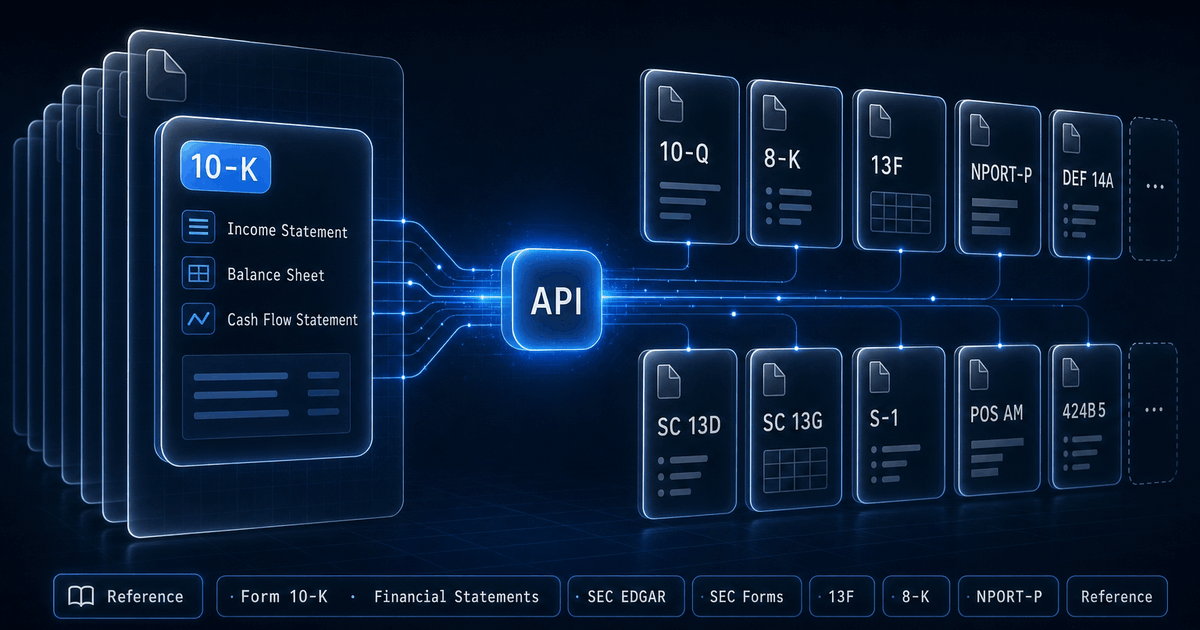
When you load Apple's revenue history, peek at Microsoft's balance sheet, or run a discounted cash flow on Costco, the numbers ultimately come from one filing: Form 10-K. The income statement, the balance sheet, and the cash flow statement — the financial statements every fundamentals API on the planet sells you — live in this single annual filing every public US company submits to the SEC.
The 10-K is the headliner, but it is one of about twenty SEC forms that carry essentially every public-market data point a developer actually uses: fundamentals, insider trades, fund holdings, executive comp, IPO terms, delistings. StockFit reads all of them so you do not have to touch a single line of XBRL or SGML. This post is the field guide. For every form we ingest, you get a one-line plain-English explanation, the actual data we pull out of it, and the exact StockFit API endpoint that serves it. If you have ever asked yourself “okay but where does the dividend history actually come from?” — answer below. (Spoiler: it's an N-CSR, not the company's 10-K.)
Form 10-K financial statements: the annual report that anchors everything
The Form 10-K is the SEC's annual report — a comprehensive disclosure every public US company has to file once per fiscal year, usually 60 to 90 days after year-end. Three of its sections do most of the heavy lifting for fundamentals work: the audited income statement, balance sheet, and cash flow statement. Around those sit segment and disaggregated-revenue disclosures, risk factors, MD&A, executive bios, accounting policies, share count, and for REITs, a per-property Schedule III real estate exhibit.
Every line item is tagged in XBRL, the SEC's structured-data format. We run each 10-K through Arelle, normalize the tags onto a stable canonical schema (so revenue is revenue across every issuer, regardless of which XBRL concept they used), classify the period, and store the raw fact alongside our curated standardized version. A typical 10-K contains six to ten thousand facts; we surface the ones that matter and keep the rest queryable for power users.
Restatements are first-class: when a company files a 10-K/A correcting last year's numbers, our pipeline keeps the per-fact, per-amendment audit trail so you can roll the financial statements back to what the market actually saw on any given Tuesday.
What we extract: The audited financial statements (income statement, balance sheet, cash flow statement, statement of equity), segment data, risk factors, MD&A, business description, share count, raw XBRL facts. Filed once per fiscal year. The single most important filing for fundamentals analysis.
Where it shows up: /api/financials/income-statement, /api/financials/balance-sheet, /api/financials/cash-flow-statement, /api/financials/key-metrics, /api/financials/growth, /api/financials/as-reported, plus the 10-K item sections (Item 1A risk factors, Item 7 MD&A, etc.) via /api/filings/item.
curl "https://api.stockfit.io/v1/api/financials/income-statement?symbol=AAPL&period=annual&limit=10" \
  -H "Authorization: Bearer YOUR_API_KEY"
That single call replays ten years of Apple's 10-K income statement, structured, deduplicated, amendment-aware. Behind it: ten 10-K filings parsed, ~70,000 XBRL facts mapped to the canonical schema, every restatement applied with full provenance.
Form 10-Q and Form 20-F: quarterly and foreign-issuer counterparts
The 10-K's siblings cover the gaps. Form 10-Q reports the same line items quarterly (unaudited, filed 40–45 days after each quarter-end). Form 20-F is the 10-K equivalent for foreign private issuers — ADRs, dual-listed companies, non-US headquartered firms like ASML, TSMC, and Spotify. Both feed the same fundamentals endpoints.
What we extract: Same financial statement line items as the 10-K, but for the quarter. Unaudited. Filed 40–45 days after quarter-end. Essential for catching fundamentals shifts between annual reports.
Where it shows up: Same endpoints as 10-K with period=quarter. Q4 is reconstructed at read time because the 10-Q is filed for Q1, Q2, and Q3 only — Q4 is what falls out of the FY 10-K minus the first nine months.
What we extract: Annual financial statements for foreign private issuers — ADRs, dual-listed companies, non-US headquartered firms (TSMC, ASML, Spotify, ARM). Replaces the 10-K. Often uses IFRS rather than US GAAP, with home-country regulatory context the 10-K omits.
Where it shows up: Same fundamentals endpoints as 10-K. Type-aware downstream so the right metrics surface for foreign filers.
Form 8-K: every material event, classified by item code
If something happens to a public company between quarterly reports — a CEO resigns, an acquisition closes, earnings get pre-released, a credit facility is amended — the SEC requires an 8-K within four business days. Each 8-K is tagged with one or more item codes (1.01, 2.02, 5.02, etc.) that tell you what kind of event it is.
We parse the SEC submission header to extract every item code on the filing, then expose them so you can build event-driven workflows: filter for 2.02 to grab earnings releases, 5.02 for executive departures, 1.01 for material agreements, 8.01 for catch-all material disclosures. For a full walkthrough of building an earnings calendar API workflow around 8-K Item 2.02 and the /api/earnings/* endpoints, see the dedicated tutorial. The 8-K Item 2.02 filing is also the recorded source of record behind accurate earnings dates, once a predicted date is confirmed and the results actually land.
What we extract: Item codes (2.02 earnings, 5.02 executive change, 1.01 material agreement, 8.01 other, 7.01 Reg FD, 5.07 vote results, etc.), filing date, document URLs, exhibit list.
Where it shows up: /api/filings with type=8-K, /api/filings/item-list, /api/filings/timeline. The full list of supported item codes is in the API docs.
IPO forms: S-1 and EFFECT
When a company wants to go public, it files Form S-1 — the IPO prospectus. It is a long document (often 200+ pages) covering the use of proceeds, financial history, risk factors, ownership structure, and the offering itself. Companies file amendments (S-1/A) repeatedly as they iterate with the SEC, each one updating price ranges, share counts, underwriter syndicates.
The actual effective date — the day the SEC clears the registration so trading can begin — lives in a separate filing called EFFECT. We pair the two: S-1 for the offering details, EFFECT (the first one per CIK) as the IPO date proxy. For the full S-1 to EFFECT timeline walked end to end on a real 2025 IPO, including the price-range amendments and the multiple-EFFECT-filings gotcha, see our SEC S-1 IPO filing data API guide.
What we extract: Use of proceeds, share counts, price range, lock-up terms, underwriter list, S-1 prospectus item sections (business, risk factors, etc.). Same XBRL pipeline as 10-K means full financial history is structured.
Where it shows up: /api/filings/offering, /api/filings/recent-offerings, /api/filings/item.
What we extract: SEC-issued notice that a registration statement is now effective. The first EFFECT per CIK is our best approximation of the actual IPO date.
Where it shows up: /api/company/details exposes ipoDate derived from this signal.
Form 25-NSE: the authoritative delisting signal
When a stock leaves an exchange, the exchange itself files Form 25 (specifically the 25-NSE variant). This is the only authoritative delisting source — not third-party scraping, not vendor classifications. The form carries a signature date that becomes the official delisted_at for the company.
Why this matters: companies often continue filing with the SEC after getting delisted (for deregistration paperwork, OTC trading), and most data vendors confuse the two. We do not. If 25-NSE has not been filed, the stock is still listed.
What we extract: Authoritative delisting date (from the exchange's own signature, not a vendor guess). Filed by NYSE, NYSE Arca, or Nasdaq.
Where it shows up: /api/company/delisted for the market-wide list, /api/company/details for individual symbols.
Insider transactions: Forms 3, 4, and 5
Section 16 of the Exchange Act requires officers, directors, and 10%+ shareholders to disclose their ownership of company stock. They file Form 3 when they first take office (initial disclosure), Form 4 every time they buy or sell (within two business days), and Form 5 once a year as a catch-up for anything that should have been on a 4 but slipped. These same filings are what power our Executive Officers API: the current CEO and executive roster, with titles, are reconstructed from Form 3/4/5 rather than the proxy. If you are shopping around for an insider-trading data API specifically, see our insider trading API comparison.
Each Form 4 carries a transaction code: P for open-market purchase, S for open-market sale, A for grant/award, M for option exercise, F for tax withholding, plus a dozen others. The code is the difference between “the CFO loaded up” and “the CFO sold to pay taxes on a vesting grant” — surface-level transaction count is meaningless without it. For an event study built specifically on P-code buys across the S&P 500, see do insider cluster buys beat the S&P 500.
What we extract: Insider name and role, transaction date, transaction code (P/S/A/M/F/etc.), shares traded, price, post-transaction holdings, derivative vs. non-derivative.
Where it shows up: /api/insider-transactions, /api/insider-transactions/by-insider, /api/insider-transactions/roster, /api/insider-transactions/summary, /api/insider-transactions/chart.
Schedule 13D and 13G: 5%+ beneficial ownership
Anyone — person, fund, family office — who acquires more than 5% of a public company's shares has to disclose it. They pick one of two flavors based on intent: 13D if they are an active investor (intend to influence management, push for changes, run a proxy fight), 13G if they are passive (index funds, long-term holders).
13D filings are the activist-investor fingerprint. When Carl Icahn or Pershing Square shows up in a name, this is the form. We classify each filing's intent (passive vs. activist) and link it back to the issuer so you can build position-tracking dashboards. For the full endpoint walkthrough, see our 13D and 13G beneficial ownership API guide.
What we extract: Owner name and CIK, position size, filing intent (active vs. passive), date acquired, percent ownership, source of funds.
Where it shows up: /api/ownership/beneficial-owners, /api/ownership/beneficial-owners/history, /api/ownership/activity.
Form 13F-HR: institutional investor holdings every quarter
Any institutional investment manager with at least $100M in qualifying assets has to file Form 13F-HR within 45 days of each quarter-end. These filings are how the public sees what Berkshire Hathaway, Renaissance Technologies, Bridgewater, Fidelity, and every other major fund actually owns — right down to position sizes by CUSIP.
Caveats: 13F is US long equities only (no shorts, no derivatives, no foreign listings), it's 45 days stale, and managers can request confidentiality on positions. But within those bounds it is the deepest free dataset on institutional positioning anywhere.
What we extract: Manager identity (CIK + name), position list with CUSIP, share count, market value, voting authority. Quarterly with a 45-day reporting lag.
Where it shows up: /api/ownership/institutional-holders, /api/ownership/institutional-holders/history, /api/ownership/portfolio, /api/ownership/institutional-holders/search.
The fund world: NPORT-P, N-CEN, N-1A, N-CSR
ETFs and mutual funds file an entirely different set of forms than operating companies do. If you are working with funds, this is where the gold is — and the data quality gap between StockFit and most fund-data vendors is widest, because most vendors stop at the prospectus. Even something as basic as mapping a fund's CIK to its current ticker turns out to be its own ordeal, because these are the filings you have to reconcile to get it right. NPORT-P is also quarterly and lagged, so when you need a fund's current book we serve issuer-published daily ETF holdings alongside it.
What we extract: Every position the fund holds (with CUSIP, ISIN, share count, fair value), total assets, total liabilities, net assets, monthly returns, sales and redemption flows. Filed monthly, three months delayed for retail availability.
Where it shows up: /api/fund/holdings, /api/fund/profile, /api/fund/flows, /api/fund/changes, /api/fund/composition, /api/fund/overlap, plus the entire /api/fund/chart/* family.
What we extract: Service providers (advisor, sub-advisor, custodian, transfer agent, auditor), risk flags raised by the fund itself (concentration, valuation, liquidity events), securities lending activity, fund structure. Filed annually.
Where it shows up: /api/fund/service-providers, /api/fund/structure, /api/fund/fund-health.
What we extract: Share class details, expense ratios, management fees, 12b-1 fees, investment objective, principal risks, fund family info. N-1A is the initial registration; 485BPOS and 497 are the ongoing updates. Also the source document behind /api/fund/exposure-model's named strategy buckets, each backed by a machine-verified quote from this exact filing.
Where it shows up: /api/fund/fees, /api/fund/fee-analysis, /api/fund/profile, /api/ownership/share-classes, /api/fund/exposure-model. See how to analyze ETF thematic exposure via API for the citation structure worked end to end.
What we extract: Per-share dividends, capital gains distributions, full audited financial statements for the fund, schedule of investments at period end, management discussion of performance.
Where it shows up: /api/fund/profile, /api/earnings/dividend-history (yes — fund dividends come from N-CSR, not from the company's 10-K).
Proxy statements: DEF 14A and DEFA14A
Once a year, ahead of the annual shareholder meeting, every public company files a proxy statement (DEF 14A). This is the document that asks shareholders to vote on board nominees, executive compensation packages, auditor ratification, and any shareholder proposals. It is also where the SEC requires disclosure of named-executive-officer compensation, peer groups, and pay-versus-performance tables.
DEFA14A is the “additional materials” companion — companies file these to amend or supplement an already-distributed proxy. We process both to extract the structured comp data, including the pay-versus-performance economics that became required disclosures starting in 2023. Our executive compensation API teardown charts how Actually Paid Compensation diverges from reported pay across sectors.
What we extract: Named executive officer compensation (salary, bonus, equity, total), peer group disclosure, pay-versus-performance tables, director independence, audit committee composition, vote results.
Where it shows up: /api/executives/compensation, /api/executives/governance, /api/executives/officers, /api/executives/performance-measures.
ARS: the glossy companion to the 10-K
The Annual Report to Shareholders (ARS) is the narrative version of the 10-K — the photo-heavy, designed PDF that shareholders actually read. It is technically a separate filing and contains material that is not in the 10-K itself: the CEO letter, branded charts, segment narratives, ESG disclosures.
We index it for document retrieval, even though most of the structured fundamentals data lives elsewhere. If you are doing LLM-based research that needs the actual narrative, the ARS is where to find management's voice in their own words.
What we extract: Document URL and exhibit list. The narrative companion to the 10-K — useful for LLM-based research workflows.
Where it shows up: /api/filings with type=ARS, /api/filings/document.
FAQ
Q.What financial statements are in a Form 10-K?
Q.What is the difference between Form 10-K and Form 20-F?
Q.What does Form 8-K Item 5.02 mean?
Q.What is the difference between Schedule 13D and Schedule 13G?
Q.How fresh is Form 13F-HR data?
Q.Why are mutual fund dividends in Form N-CSR and not the company's annual report?
Q.What is the difference between Form NPORT-P and Form N-CEN?
Q.What is the “effective date” of an IPO and how do I find it?
EFFECT. We use the first EFFECT per CIK as the IPO date and surface it on /api/company/details as ipoDate.Q.Is a company that filed a Form 25-NSE actually delisted?
Where to start
If you are building anything that touches public-company data, the answer to “where does this come from?” is almost always one of the forms above. The StockFit API gives you direct access to every dataset linked in this post — fundamentals, insider trades, fund holdings, executive comp, IPOs, delistings — with the fundamentals and the filing index on the free tier and the rest on paid plans.
Two recommended next reads: Converting XBRL Financials to JSON for Backtesting if you want to understand how the 10-K and 10-Q pipelines actually work, and A Deep Lens on Any ETF if you are working with funds and want to see NPORT-P / N-CEN in practice.
Or just grab a key and start poking. The API will surprise you with how much is in there.
Ready to build?
Free API key, no credit card.