Restructuring Charges API: Serial Costs at Intel
Get per-program restructuring charges from SEC XBRL: cumulative costs to date, cash payments, reversals, and why Intel's one-time charges keep repeating.
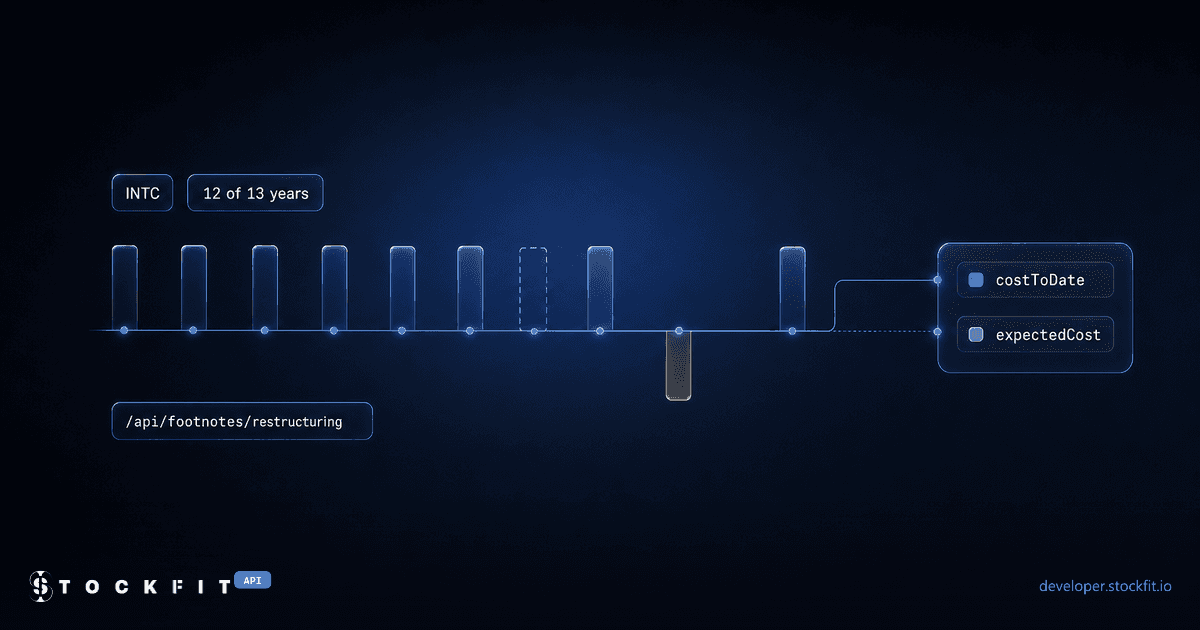
Restructuring charges are filed as one-time costs, and Intel's own filings show why that label needs care: a named restructuring plan or program reported a charge in 12 of the 13 fiscal years from the one ended 2013-12-28 to the one ended 2025-12-27. The 2025 plan and the 2024 plan are both still open, and the 2024 plan appears twice in the same API response.
The reason you can see any of this is the restructuring footnote, which filers tag in XBRL. The /api/footnotes/restructuring endpoint returns one series per plan or program, each with the cumulative cost to date, the expected total, the accrual booked in each period, the cash paid and the reserve still open. Every per-period row carries the filing that supplied it in dateFiled, while the cumulative and expected figures sit on the series object and come from whichever view you asked for, annual or quarterly, so name that view next to them. Below: the response, Intel's member-by-member history, the two ways to count the same plan twice, the cash timing trap, the reversals, and what each tier gives you. All figures pulled 2026-11-12.
Are restructuring charges one-time? Intel's filings say no
A restructuring charge is the accounting for exit or disposal activities: severance and benefits for people leaving, lease and facility exits, and impairments of assets the company no longer needs. The charge is "one-time" in the narrow sense that a single program ends, which is not the same as the company charging once. Intel (INTC) has run one program after another for more than a decade, and the endpoint carries every one of them.
| Fiscal year ended | Member in the response | Field | Charge |
|---|---|---|---|
| 2013-12-28 | Restructuring Program One | costIncurred | $240M |
| 2014-12-27 | Restructuring Program One | costIncurred | $295M |
| 2015-12-26 | Restructuring Program Two | charges | $306M |
| 2016-12-31 | Restructuring Program Three | costIncurred | $1,681M |
| 2017-12-30 | Restructuring Program Three | costIncurred | $135M |
| 2018-12-29 | Restructuring Program Three | costIncurred | -$72M |
| 2019-12-28 | A 2019 Restructuring Program | costIncurred | $393M |
| 2020-12-26 | A 2020 Restructuring Program | costIncurred | $198M |
| 2021-12-25 | none tagged | no row | |
| 2022-12-31 | A 2022 Restructuring Program | charges | $1,038M |
| 2023-12-30 | A 2022 Restructuring Program | charges | $222M |
| 2024-12-28 | A 2024 Restructuring Plan | charges | $2,306M |
| 2025-12-27 | A 2025 Restructuring Plan | charges | $1,450M |
The Field column is the point of the table. Programs from 2022 onward tag charges, which is the accrual column of the filer's severance roll-forward. The older programs tag costIncurred instead, and three of them tag both. So this is not one series you can chart end to end; it is one series per member, in the member's own field. Read it as evidence of recurrence, not as a ten-year total.
Two caveats before you quote the count. First, where two members report in the same year, the table shows the larger: Restructuring Program One also reported $90M costIncurred for the year ended 2015-12-26, and A 2016 Restructuring Program reported $1,414M costIncurred for the quarter ended 2016-07-02. Second, the one gap, the year ended 2021-12-25, means no member tagged a charge in that year, not that the company spent nothing on restructuring. The statements endpoint does carry a figure for that year, $2,626M in both restructuring fields, but the restructuringCharges side of it is served from the FY2022 10-K comparative column, not from the year's own 10-K, so it does not belong in the same series as the years around it. The statements lines and the per-program footnote are separate datasets with separate histories.
The restructuring charges API returns one series per plan
One request returns every program the filer has tagged, each with its own history:
curl "https://api.stockfit.io/v1/api/footnotes/restructuring?symbol=INTC&period=annual&limit=3" \
-H "Authorization: Bearer YOUR_API_KEY"{
"programs": [
{
"member": "intc:A2025RestructuringPlanMember",
"name": "A 2025 Restructuring Plan",
"currency": "USD",
"costToDate": 2000000000,
"expectedCost": 2200000000,
"history": [
{
"period": "2025-12-27", "fiscalYear": 2025, "fiscalPeriod": "FY",
"dateFiled": "2026-10-30",
"charges": 1450000000, "cashPayments": 1033000000, "reserve": 417000000
}
]
},
{
"member": "intc:A2024RestructuringPlanMember",
"name": "A 2024 Restructuring Plan",
"currency": "USD",
"costToDate": 3100000000,
"history": [
{
"period": "2025-12-27", "fiscalYear": 2025, "fiscalPeriod": "FY",
"dateFiled": "2026-01-23",
"charges": 265000000, "cashPayments": 541000000, "reserve": 26000000
},
{
"period": "2024-12-28", "fiscalYear": 2024, "fiscalPeriod": "FY",
"dateFiled": "2026-01-23",
"charges": 2306000000, "cashPayments": 2004000000, "reserve": 302000000
}
]
}
],
"costTypes": [ /* severance, impairments: components, not programs */ ]
}The fields you will actually use:
Reading the per-program fields
costToDate: what the filer has charged against the plan so far, including non-cash impairments. Absent when the filer never tagged a cumulative figure.expectedCost: the filer's estimate of the total. Also optional, and often absent on the newer members.charges: the accrual booked in that period. On Intel this is the severance roll-forward accrual, so it excludes impairments and never equals the plan total.cashPayments: what actually left the bank in the period.reserve: the accrued liability still open at the period end, which is the number the next quarter's roll-forward starts from.dateFiled: the filing that supplied the row. Keep it in your output, because it is how you tell two snapshots of the same plan apart.
The response also carries costTypes, which are cost categories (severance, impairments) rather than programs. They are components of the older programs: Intel's Employee Severance And Benefits member carries $466M of cumulative cost and the impairment member $69M. Adding them to the program members would count the same spend twice, so the two arrays are served separately and the documentation says not to mix them.
One cross-endpoint detail worth knowing before you join anything. The statements endpoints print Intel's fiscal year ended 2025-12-27 as 2025-12-26, while the footnote endpoint prints it as 2025-12-27 and the 10-K cover says 2025-12-27. Join on fiscalYear, never on the period string, or you will drop rows for no reason. The annual response for Intel carries 10 program members and 7 cost type members, 17 in total.
Intel's restructuring history, member by member
The seven members that carry a cumulative figure or an open reserve, as served on 2026-11-12. The Filing column is the filing each figure traces to:
| Member | costToDate | expectedCost | Reserve | Reserve as of | Filing |
|---|---|---|---|---|---|
| A 2025 Restructuring Plan | $2.0B | $2.2B | $417M | 2025-12-27 | FY2025 10-K, filed 2026-01-23 |
| A 2024 Restructuring Plan | $3.1B | not tagged | $26M | 2025-12-27 | FY2025 10-K, filed 2026-01-23 |
| A 2024 Restructuring Program | $2.8B | $3.0B | $302M | 2024-12-28 | FY2024 10-K, filed 2025-01-31 |
| A 2022 Restructuring Program | $1.3B | not tagged | $0M | 2024-12-28 | FY2025 10-K, filed 2026-01-23 |
| Restructuring Program One | $0.6B | not tagged | $38M | 2015-12-26 | FY2015 10-K, filed 2016-02-12 |
| Restructuring Program Two | not tagged | not tagged | $70M | 2015-12-26 | Q3 2016 10-Q, filed 2016-10-31 |
| Restructuring Program Three | not tagged | not tagged | $325M | 2017-12-30 | FY2018 10-K, filed 2019-02-01 |
Read the top two rows together and you have the current picture. The 2025 plan was expected to cost $2.2B and had charged $2.0B as of 2025-12-27, with $417M of severance still accrued. The 2024 plan had charged $3.1B by the same date, and its reserve was down to $26M. The row directly below them, A 2024 Restructuring Program, is that same 2024 plan under an older label, which is the next section.
A cumulative figure is only meaningful with its as-of filing, because the two views of the endpoint serve different snapshots. The 2025 plan is $2.0B in the annual view, the figure the FY2025 10-K states for 2025-12-27, and $2.2B in the quarterly view, the figure the Q3 2026 10-Q states for 2026-09-26. The 2024 plan goes from $3.1B to $3.2B across the same two filings. Neither number is stale: one is the year-end position and one is three quarters later. Print the filing next to the figure, or a reader who checks your page against the other filing will think you got it wrong.
The older members show the same fields used for smaller programs. Restructuring Program One carries a cumulative $625M across the fiscal years ended 2013-12-28 to 2015-12-26. Restructuring Program Two and Restructuring Program Three never got a cumulative figure at all, only per-period rows, which is why their costToDate cells read not tagged, and each still carries a reserve forward into a later filing. An empty cell is a fact about the tagging, not about the program.
The same 2024 plan appears twice in one response
This is the trap that costs you a wrong number. The annual response contains both intc:A2024RestructuringPlanMember and intc:A2024RestructuringProgramMember, and both carry the same fiscal 2024 rows: $2,306M of charges, $2,004M of cashPayments and a $302M reserve at 2024-12-28. They are one plan. Add the two members' fiscal 2024 charges and you get $4,612M for a year whose own roll-forward reports $2,306M.
The filings explain it. The FY2024 10-K names the 2024 Restructuring Plan in prose and tags it under intc:A2024RestructuringProgramMember, the member the endpoint serves for that plan. The endpoint's Program member serves the fiscal 2024 row with dateFiled2025-04-25, a later 10-Q that repeated the comparative, while the Plan member serves the same row with dateFiled 2026-01-23, the FY2025 10-K. In the FY2025 10-K, FY2025 10-K Note 7 table header: "2025 Restructuring Program | 2024 Restructuring Program | 2022 Restructuring Program", while the prose in the same note says "2025 Restructuring Plan", "2024 Restructuring Plan" and "2022 Restructuring Program". So Intel calls the same initiative a plan in prose and a program in the table above it, and both labels reach XBRL as separate members with overlapping histories.
The duplication is not unique to that plan. intc:RestructuringProgramThreeMember and intc:INTCRestructuringProgramThreeMember both report $184M of costIncurred for the quarter ended 2019-06-29, filed 2019-07-26 and 2020-07-24 respectively. Same quarter, same amount, two members, two filings.
A dedupe that works on the values
import requests

r = requests.get("https://api.stockfit.io/v1/api/footnotes/restructuring",
                 params={"symbol": "INTC", "period": "annual", "limit": 3},
                 headers={"Authorization": "Bearer YOUR_API_KEY"}, timeout=30)
r.raise_for_status()

seen = {}
for program in r.json()["programs"]:
    for row in program["history"]:
        key = (row["period"], row.get("charges"), row.get("cashPayments"))
        if key[1] is None and key[2] is None:
            continue                      # reserve-only row, nothing to double count
        if key in seen:
            print("duplicate:", program["name"], row["period"], "also", seen[key])
        else:
            seen[key] = program["name"]
The rule that follows: never sum across members of the same plan, and name the filing for every figure you publish. When two members disagree on costToDate ($2.8B against $3.1B for the 2024 plan), that is not a conflict to average, it is two filing dates, and the later one wins for a current figure.
The P&L charge and the cash payments land in different years
A restructuring charge is an accrual. The income statement takes it when the obligation is committed, and the cash leaves as the people and leases wind down, which is why the two numbers rarely match in the year they land. Intel's 2024 plan charged $2,306M in the fiscal year ended 2024-12-28 and paid $2,004M of it that year, then $541M more in the year ended 2025-12-27. The P&L took the whole charge in one year; the cash crossed two.
The 2025 plan is still running through the same shape. It charged $1,450M and paid $1,033M in the year ended 2025-12-27, leaving $417M accrued. The next 10-Q rolls that forward: $417M open at 2025-12-27, plus $228M of accruals and adjustments, minus $463M of cash payments, is $182M at 2026-09-26. The endpoint serves the same member's reserve at each period end ($417M at 2025-12-27, $182M at 2026-09-26) plus the cash paid where the filer tagged it: the quarterly view carries a $159M payment on the row for the quarter ended 2026-03-28, and the two quarters since then carry the reserve only. You can rebuild most of the table from the API and check the rest against the filing.
Two field rules that keep this honest. First, charges is the accrual column of the severance roll-forward only. The FY2025 10-K says the 2025 plan's severance net charges were $1.5 billion, matching the endpoint's $1,450M, while the plan's costToDate of $2.0B is not severance alone: the same filing attributes $474M of non-cash impairment charges to the 2025 and 2024 plans together. So never sum charges and compare the total to costToDate: they are different concepts that happen to sit in the same object. Second, if you want the cash from operations around the charge, use the /api/financials/cash-flow-statement endpoint, but note that restructuring cash is not a line of its own there, it sits inside operating activities. The per-plan cash payments come from the footnote roll-forward, not from the statement.
Restructuring reversals: when the one-time charge is negative
A restructuring charge can be negative. That is a reversal: the company revised an estimate down and took the difference back through the same line. The restructuringCharges figure for the fiscal year ended 2023-12-30 is -$424M, and the per-program rows carry six more negative periods:
| Period end | Member or line | Field | Value |
|---|---|---|---|
| 2023-12-30 | Cash flow statement line | restructuringCharges | -$424M |
| 2018-12-29 | Restructuring Program Three | costIncurred | -$72M |
| 2017-07-01 | Restructuring Program Three | costIncurred | -$42M |
| 2017-04-01 | Restructuring Program Three | costIncurred | -$11M |
| 2020-09-26 | A 2020 Restructuring Program | costIncurred | -$25M |
| 2015-09-26 | Restructuring Program One | costIncurred | -$8M |
| 2015-06-27 | Restructuring Program One | costIncurred | -$2M |
If your pipeline takes the absolute value, or treats a negative charge as a parsing error and drops the row, you lose real information. Restructuring Program Three charged $1,681M in the year ended 2016-12-31 and then reversed part of it three times, -$11M in the quarter ended 2017-04-01, -$42M in the quarter ended 2017-07-01 and -$72M in the year ended 2018-12-29. That is the normal life of a plan, not a data problem.
The other half of that section is field discipline, and it starts with which statement a field came from. The statements endpoint returns two restructuring fields and they are not interchangeable. restructuringCharges is served from the us-gaap:RestructuringCharges tag, which Intel tags on the cash flow statement line "Restructuring and other charges", inside "Adjustments to reconcile net income (loss) to net cash provided by operating activities": $476M in the year ended 2025-12-27, $3,491M the year before, -$424M in 2023-12-30. Check the -$424M for the year ended 2023-12-30 against Intel's income statement and you will not find it. restructuringAndImpairmentTotal is served from us-gaap:RestructuringSettlementAndImpairmentProvisions, and that is the income statement line, matching the filing's "Total restructuring and other charges" table exactly: $2,191M, $6,970M and -$62M for the same three years.
Pick one series, name it in your output, and do not splice them together across years. The -$62M total is the more interesting of the two for 2023-12-30: it is a net benefit, because the year included a $1.2B benefit from reducing a previously accrued litigation charge while the severance line still cost $222M.
What the free tier gives you, and what needs Pro
Per-program data is a Pro feature. /api/footnotes/restructuring is on the Pro plan, with the rest of the footnotes family, and it is what gives you costToDate, expectedCost, the reserve and the per-period rows.
Two free endpoints cover the rest of the workflow. The /api/financials/income-statement endpoint returns Intel's income statement restructuring line, restructuringAndImpairmentTotal, and it is on every plan, including Free. History depth is what the plan buys: Free returns one annual period, so without a paid plan you get the latest fiscal year, $2,191M for the year ended 2025-12-27. The three-year series quoted above, $2,191M, $6,970M and -$62M, needs Starter (10 annual periods) or Pro (the full history). The /api/filings/search-by-accession-number endpoint is free as well, and it turns any accession number from the response into the filing URL, form type and dates, which is how you check a figure against the source before you publish it. Pass 0000050863-26-000011 and you land on the 10-K the 2025 plan figures come from.
The same dataset is available to AI assistants through the StockFit MCP server as the tool footnotes_restructuring, so an agent can pull the per-program series and the filing date behind each row instead of guessing. Setup is on the MCP page. to try the free endpoints first.
The same discipline applies to the other footnote datasets: the pension funded status API, the debt tranche structure API and the supplier finance obligations study all read the same way, one series per filing, with the filing named. If you are using the charge to adjust earnings, the financial health score API shows what the scores do when a one-time item is not adjusted out.
FAQ
Q.Are restructuring charges one-time costs?
Q.What is the difference between a restructuring plan and a restructuring program in SEC filings?
intc:A2024RestructuringPlanMember and intc:A2024RestructuringProgramMember, carrying the same fiscal 2024 rows. Treat the label as a tag, and dedupe on the values.Q.Can restructuring charges be negative?
restructuringCharges for the fiscal year ended 2023-12-30 is -$424M, the cash flow statement tag rather than the income statement line, and Restructuring Program Three carries -$72M of costIncurred for the year ended 2018-12-29. Do not take absolute values and do not treat the sign as a parsing error.Q.What is cost to date versus expected cost in a restructuring footnote?
costToDate is what the filer has charged against the plan so far, and it includes non-cash items such as asset impairments. expectedCost is the filer's estimate of the total the plan will cost. Both are optional. Intel's 2025 plan tags both a cumulative figure ($2.0B as of 2025-12-27) and an expected total ($2.2B); the 2024 plan member tags only a cumulative figure. Never compare costToDate to the sum of the per-period charges, because those are severance accruals and cover a narrower set of costs.Q.Why does a restructuring charge hit the income statement before the cash is paid?
Q.Which API returns per-program restructuring data?
/api/footnotes/restructuring, on the Pro plan. One request returns every plan or program the filer has tagged, with costToDate, expectedCost, the per-period charges, cashPayments and reserve, plus the dateFiled of the filing behind each row. The same data is exposed to AI assistants as the MCP tool footnotes_restructuring.Q.Is restructuring data available on the free StockFit tier?
restructuringCharges and restructuringAndImpairmentTotal, but Free returns one annual period, so the free call gives you the latest fiscal year only: $2,191M for the year ended 2025-12-27. The three-year series needs Starter (10 annual periods) or Pro. The filings endpoint that resolves an accession number to the filing URL is free as well, so the receipts are free even when the per-program detail is not.Q.How do I avoid double counting Intel's 2024 restructuring members?
charges and cashPayments for each row, and when two members produce the same key, keep one and note the other. Both intc:A2024RestructuringPlanMember and intc:A2024RestructuringProgramMember report $2,306M of charges and $2,004M of cash payments for the year ended 2024-12-28, so summing them gives $4,612M for a year the roll-forward reports as $2,306M. The same rule catches the duplicate Restructuring Program Three pair.Ready to build?
Free API key, no credit card.