Mapping CIK to Fund Tickers: A Practical Guide
Mapping a fund's CIK to its ticker is brutally hard: the SEC submissions feed carries none, company_tickers_mf.json lags months, and tickers get recycled.
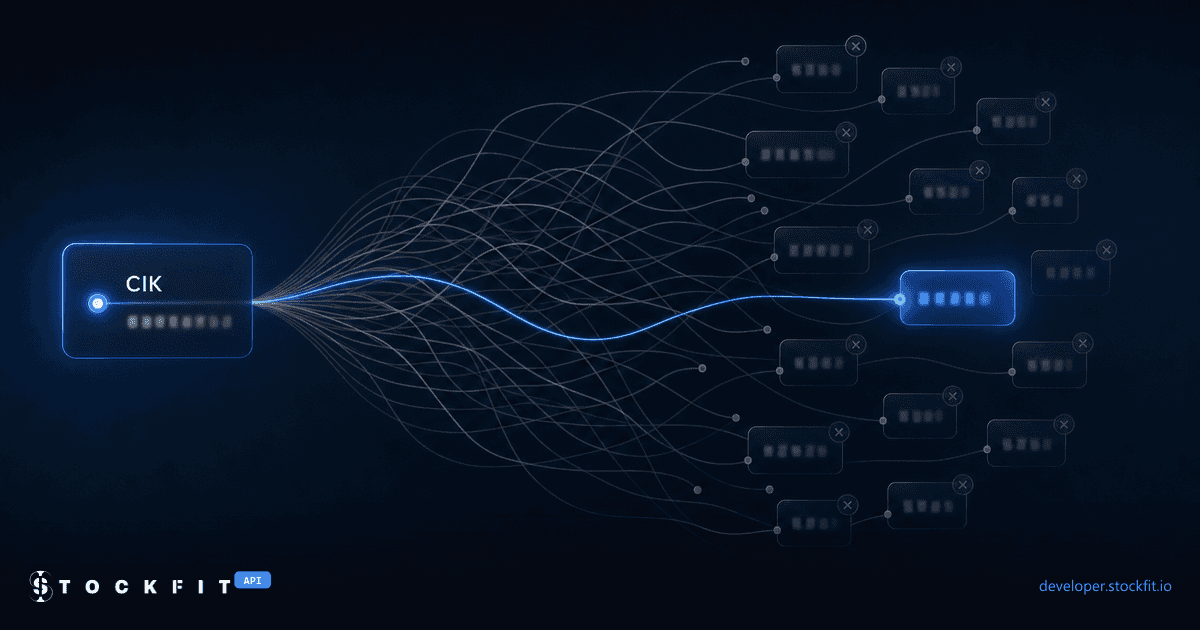
For an operating company, mapping a SEC EDGAR CIK to its ticker is a single lookup. Apple is CIK 320193, ticker AAPL, and SEC ships a file that says exactly that. So when you reach for a fund's ticker, you reasonably assume it works the same way. It does not. There is no SEC EDGAR source that hands you a fund's current ticker correctly. The bulk submissions feed carries none. The dedicated fund file lags reality by months. The real answer has to be reconstructed from the fund's own filings.
This post is the journey we took to get correct, current fund tickers out of EDGAR, what each obvious source gets wrong, why it is structurally hard, and the classification framework that actually works. The short version: it is far too much work for what should be the most basic fact about a fund, and SEC is the one making it hard.
For stocks, a CIK maps to a ticker in one file
SEC publishes company_tickers.json: a flat list of CIK, ticker, and company name for every operating company. One fetch, one join, done. It is correct, it is current, and it covers the entire equity universe including the commodity and crypto grantor trusts (GLD, SLV, IBIT) that file like operating companies. If your world is stocks, fund tickers feel like they should be a rounding error of additional work.
They are not, because a registered fund is not an entity with a ticker. It is a trust that holds many series (the individual funds), and the tickers live on the series, not the trust. Every source you reach for falls down on that one structural fact, in a different way each time.
Attempt 1: the EDGAR submissions feed has no fund tickers
The first stop is the EDGAR submissions data (the bulk submissions.zip, one JSON document per CIK). Each entity's JSON has a tickers array. For Apple it is ["AAPL"]. For a fund trust, the entity that actually files with EDGAR, it is:
{
  "cik": "1540305",
  "name": "ETF Series Solutions",
  "entityType": "investment",
  "tickers": [],
  "exchanges": []
}
Empty. ETF Series Solutions sponsors dozens of live, actively traded ETFs, and its submissions record lists exactly zero tickers. The same is true of nearly every multi-series fund trust: iShares Trust, Vanguard, SPDR Series Trust, all of them. The submissions feed carries tickers at the entity level, and a registered fund trust has no entity-level ticker to carry. So the most obvious, most authoritative-looking source returns nothing for essentially the entire registered-fund universe.
Attempt 2: company_tickers_mf.json lags reality by months
SEC does have a dedicated fund file: company_tickers_mf.json, which maps each fund series and class to a ticker. Progress, finally a source that knows funds have tickers. Except it carries the registration ticker, the symbol on file with SEC, and it lags the market by months:
Renames stay stale
When State Street renamed the SPDR Portfolio S&P 500 ETF and changed its symbol from SPLG to SPYM, the file kept serving the old ticker well after the change was live on the tape. Anyone resolving that series from company_tickers_mf.json got a symbol that no longer traded.
Liquidations stay listed
When a fund liquidates, it does not vanish from the file on the day it stops trading. It lingers, indistinguishable from a live fund, until the registration catches up. If you trust the file, you keep handing out tickers for funds that no longer exist.
Recycled tickers point at the corpse
This is the one that hurt. Ticker symbols get recycled. IBIT was the symbol of a small, now-liquidated Defiance ETF before BlackRock reused it for the iShares Bitcoin Trust. A naive lookup against a stale file hands you the dead fund, on the wrong exchange, under a different sponsor. The symbol is a string; what it points at changes over time, and the file is slow to notice.
So the dedicated fund file is a snapshot of paperwork, not of the market. It is better than nothing, which is what the submissions feed gave us, but it is not an answer you can ship.
Why a fund's ticker is so hard to pin down
Step back and the reason no single file can be right becomes structural, not a bug SEC will patch:
- One CIK maps to many funds and many tickers (series and share classes under a single trust).
- Funds rename, and their tickers change, on their own schedule.
- Tickers get recycled across completely unrelated issuers, sometimes years apart.
- Funds liquidate and merge constantly, and the registration files reflect death slowly.
- SEC's own sources disagree: a fund missing from the submissions feed can be current in the fund file, which can be stale versus the exchange.
None of SEC's files tracks the current truth, because they are registration artifacts, not a live securities master. A fund's ticker is not a static field; it is the running state of a series that is being renamed, relisted, recycled, and wound down over its life. Treating it as a cell in a JSON file is the original mistake.
The framework: classify the filer, then derive the ticker
The approach that produces correct, current fund tickers has two moves. The first is a classification step that decides how to resolve a ticker; the second is a derivation step for the hard class.
1. Classify the filer by what it files, not what it is named
The form family a CIK files tells you where its ticker lives:
- Files 10-K / 8-K (operating companies, and commodity or crypto grantor trusts like GLD or IBIT): the ticker is an entity-level fact. Read it straight from the submissions feed, the same path as a stock.
- Files N-CEN / NPORT-P / 497 (the registered 1940-Act funds, which is most ETFs and mutual funds): the ticker is a series-level fact that has to be derived from the fund's own filings.
Classifying by name is a trap, plenty of grantor trusts have fund-like names and plenty of funds have plain ones. Classifying by the forms a CIK actually files is robust, because the form family is a regulatory fact, not a marketing choice. (For a tour of those fund forms and what each carries, see our field guide to the SEC forms we read.)
2. For registered funds, treat the ticker as an event stream, not a field
For the registered-fund class, you reconstruct “what is this series trading under right now, and is it even still alive?” from the fund's own periodic and event filings:
- the annual census filing (N-CEN) gives the current ticker snapshot per series,
- the monthly portfolio reports (NPORT-P) confirm the fund is still alive, or that it filed its final one,
- the prospectus supplements (497) carry the change events: renames, ticker swaps, liquidations, and mergers.
Reconcile those into a single current answer and the hard cases fall out correctly: a renamed series resolves to its new symbol, a recycled ticker resolves to the live holder rather than the dead one, and a liquidated fund resolves to delisted instead of silently active. The mental shift is the whole trick. Stop looking the ticker up; start deriving it. A fund's current ticker is the output of its filing history, not a value you can read from one file.
That is a real pipeline rather than a lookup, which is exactly why a clean fund-ticker resolution is worth not building yourself. It is what sits behind the StockFit fund endpoints: resolve a ticker or CIK with /api/lookup/symbol and /api/lookup/cik, pull a fund's current profile with /api/fund/profile, and track series-level changes through /api/fund/changes. Delistings, including funds that liquidated quietly, surface on /api/company/delisted. If you are working with funds end to end, the deep lens on any ETF walks the NPORT-P and N-CEN endpoints in practice.
A wrong fund ticker is always a bug
There is no version of a wrong ticker that is acceptable. A stale or recycled symbol silently resolves a user, a holdings join, or a backtest to the wrong fund, and nothing throws, because the string still looks like a valid ticker. For an API whose entire job is to be correct, handing back yesterday's symbol, or one that now belongs to a different fund, is a defect, full stop, never a cosmetic detail. The damage only compounds downstream: a fund that quietly liquidated but stays listed in a stale file is textbook survivorship bias, and a recycled ticker splices two unrelated funds' histories into one series. Getting the current ticker right, and knowing exactly when a fund went dark, is the same discipline as keeping a clean point-in-time history on the equity side: the data has to reflect what was true on the day, not what the registration file says today.
FAQ
Q.Why doesn't a fund's CIK have a ticker in SEC's submissions data?
tickers array is empty even when it sponsors dozens of actively traded ETFs. The tickers belong to the individual series, which the submissions feed does not expose. Operating companies and grantor trusts (like GLD or IBIT) do carry an entity-level ticker, so for them the submissions feed works fine.Q.What is company_tickers_mf.json and why is it stale?
Q.Can ticker symbols be reused by different funds?
Q.How do you get a fund's current ticker from SEC EDGAR?
Q.What is the difference between a fund trust and a fund series?
Q.How do you tell if a fund has been delisted or liquidated?
Q.Which SEC filings carry a fund's ticker and ticker changes?
Where to start
A fund's current ticker is the most basic fact about it, and there is no SEC EDGAR endpoint that just gives it to you correctly. The bulk submissions feed has nothing, the dedicated fund file is months stale, and the real answer has to be rebuilt from N-CEN, NPORT-P, and 497 filings while dodging recycled tickers and silent liquidations. It is far too hard for what it is, and SEC made it that way.
If you would rather not build that pipeline, it is already done: resolve any fund by ticker or CIK with /api/lookup/symbol and /api/fund/profile, on the free tier. Two good next reads: the field guide to the SEC forms we read for how N-CEN and NPORT-P fit together, and the deep lens on any ETF for the fund endpoints in practice. Once a fund is resolved, you can also pull its daily ETF holdings straight from the issuer file, far fresher than quarterly N-PORT, or compare its expense ratio and fee schedule against the same N-1A and N-CEN filings this post already has you reading, or look up its custodian and service-provider roster from the same N-CEN census.
Ready to build?
Free API key, no credit card.