Fundamental Stock Analysis Explained
How investors use fundamental stock analysis to value companies, screen stocks, and build conviction, plus the financial data inputs behind every step.
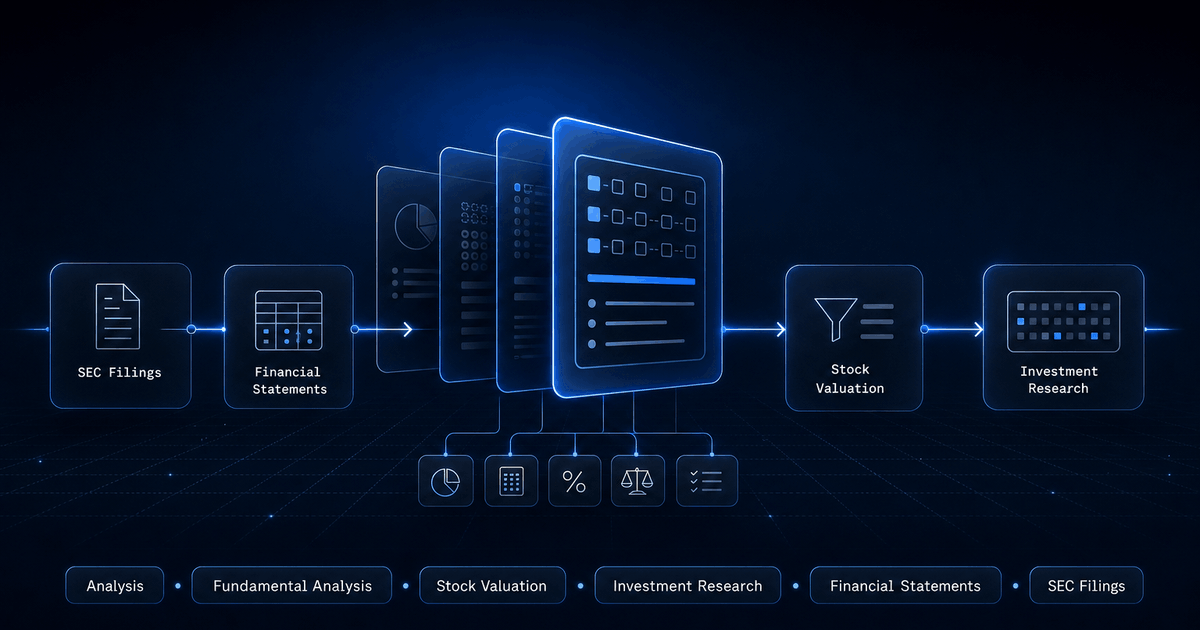
Fundamental stock analysis is the practice of estimating what a company is actually worth, then comparing that to what the market is charging. It is the discipline behind every long-term investor who has ever asked whether a stock is cheap, whether a business is durable, or whether the headline number on the earnings report is real cash. This post is not a tutorial on running a discounted cash flow or reading a 10-K line by line. It is the field guide to what fundamental stock analysis is used for, how investors actually do it, and which API endpoints power each step of the workflow.
What Fundamental Stock Analysis Is, and Isn't
Fundamental stock analysis evaluates a company by studying the business behind the ticker: revenue, margins, cash flow, leverage, competitive position, the quality of management, and the credibility of the accounting. The output is an estimate of intrinsic value: what the equity is worth based on its expected cash flows, the durability of those cash flows, and the price of risk. If the stock trades meaningfully below that estimate it is a candidate to buy. If it trades far above, it is a candidate to avoid or short.
Technical analysis is the other major school. It looks at price and volume patterns, momentum, and chart formations. The two approaches answer different questions. Fundamentals ask “what is this business worth?” Technicals ask “what is the market doing right now?” A trader can use technicals to time an entry on a stock the fundamentals already approved of. A long-term investor can ignore technicals entirely. Most professional investors blend the two; the framework below is the fundamentals half.
Fundamental stock analysis is also not a single method. It covers everything from full-blown discounted cash flow models with three-stage assumptions, to multiples comparisons against peers, to sum-of-the-parts breakdowns for conglomerates. The thing that unifies them is the input data: audited financial statements, normalized growth and quality metrics, ownership signals, and the SEC filings underneath all of it. Where you source that data matters, which is the subject of our roundup of the best fundamentals APIs.
Why Investors Use Fundamental Stock Analysis
Five concrete use cases account for the overwhelming majority of fundamental work done in equities. They overlap, but the goal of each is different.
Valuation
The most familiar use of fundamental stock analysis is producing a price target for a stock. Discounted cash flow projects free cash flow over a horizon, applies a discount rate, and discounts back to present value. Comparable analysis takes the multiples of similar companies (price-to-earnings, EV-to-EBITDA, price-to-sales) and applies them to the subject, which first requires a defensible peer set, the job of the Company Peers API. Sum-of-the-parts breaks a conglomerate into segments, values each separately, and adds them up. All three need the same raw inputs: a clean income statement, balance sheet, and cash flow statement going back several years.
Stock Screening
Before valuing one stock you usually want to narrow a universe of thousands to a working list of dozens. Fundamental screens filter on profitability (operating margin, return on invested capital), quality (Piotroski F-Score, accruals ratio), leverage (debt-to-equity, interest coverage), and growth (revenue and free cash flow CAGRs). A screen turns the question “which stocks are worth analyzing?” into a query against a structured data set. Even discretionary investors use screens to surface candidates they would otherwise miss.
Conviction and Position Sizing
A buy thesis is not a portfolio weight. Two stocks that both appear undervalued can deserve very different sizes depending on the strength of the underlying business, the reliability of the cash flows, and the asymmetry between upside and downside. Fundamental stock analysis is what an investor uses to convert qualitative conviction into a number. Stronger evidence (recurring revenue, cash-rich balance sheet, decade of consistent margins) earns a larger position. Weaker evidence (cyclical, highly leveraged, one-product company) earns a smaller one.
Avoiding Value Traps and Accounting Red Flags
A cheap stock is sometimes cheap because the market is right. Fundamental analysis is the work of distinguishing a genuine bargain from a value trap. The signals come from earnings quality (does net income convert to operating cash flow, or is it growing through receivables?), balance sheet health (is the cash pile real, or is debt creeping up faster than equity?), and consistency of disclosure (do the segments add up, do the restatements concentrate in one area?). Most accounting fraud cases would have been catchable with a Saturday afternoon of cash-flow comparison and ratio checks before they blew up.
Credit and M&A Diligence
Equity investors are not the only consumers of fundamental analysis. Credit analysts use the same data to assess covenant headroom and the probability of default. M&A teams use it to model post-deal capital structures, identify synergies, and price contingent considerations. The questions they ask differ from a stock picker's, but the inputs do not.
The Five-Step Workflow Most Analysts Follow
There is no single right way to do fundamental stock analysis, but most professional and serious-amateur workflows follow the same five steps. They are sequential, but in practice you loop back constantly as new information surfaces.
1. Understand the Business
Every model starts with the same question: how does this company actually make money? You want the sector, the industry classification, the size, the geographic footprint, the customer concentration, and the fiscal-year calendar (which is not always January through December). A retail company on a 52-week fiscal calendar with a January year-end gets analyzed very differently from a software company on calendar-quarter rhythm. Skipping this step is the most common reason a model produces nonsense numbers.
Quick context calls: /api/company/details, /api/company/research-summary, /api/company/economic-model. The economic-model endpoint returns a structured business-model analysis (offerings, cost structure, flywheels, failure modes) with citations back to the underlying SEC filings, useful when you need to defend a claim in a memo; see the full verification walkthrough for how those citations get checked.
2. Read the Financial Statements
The three financial statements are the foundation. The income statement (revenue, costs, margins, net income) tells you how profitable the business is. The balance sheet (assets, liabilities, equity, cash, debt) tells you how solvent it is and how aggressively it is funded. The cash flow statement (operating, investing, financing) tells you whether the income is converting to actual money. Read at least five years and ideally ten, because a one-year snapshot can be dressed up. A decade is hard to fake.
Pull the statements: /api/financials/income-statement, /api/financials/balance-sheet, /api/financials/cash-flow-statement. Each returns a normalized canonical shape (revenue is always revenue, regardless of which XBRL concept the issuer used) with the original SEC filing date attached.
3. Quantify Health, Quality, and Growth
Raw statements are an input. The next step is converting them into ratios and scores that travel across companies: operating margin, return on equity, return on invested capital, debt-to-EBITDA, interest coverage, Piotroski F-Score, Altman Z-Score. Growth rates come next: revenue CAGR over three and five years, free cash flow CAGR, EPS CAGR. The earnings-quality check (operating cash flow versus net income) goes here too. Numbers that read clean on the income statement frequently fall apart at this layer.
Use the curated metric endpoints: /api/financials/key-metrics, /api/financials/scores, /api/financials/growth, /api/earnings/trends, and /api/earnings/chart/quality. The key-metrics endpoint returns sector-aware ratios, so banks see net interest margin and tier-1 capital, REITs see funds-from-operations, and software companies see operating-margin-on-recurring-revenue.
4. Triangulate with Ownership Signals
A clean fundamentals picture should be corroborated by who else is buying. Institutional holdings (filed quarterly on Form 13F) show whether respected long-only managers are accumulating or trimming. Insider transactions (Forms 3, 4, and 5) show whether the people who run the company are putting their own cash in or pulling it out. Neither signal is decisive on its own, but a thesis built only on fundamentals while every insider sells should give you pause.
The ownership endpoints: /api/ownership/institutional-holders, /api/ownership/summary, /api/insider-transactions, and /api/insider-transactions/summary. The summary endpoints aggregate trailing 3-, 6-, and 12-month insider activity so you can read it as a single number per ticker.
5. Decide and Monitor
The final step is the decision (buy, hold, pass) and the position size. After that, the work continues. Quarterly earnings come out four times a year, and each report is a chance to test the thesis. Did revenue grow as expected? Did margins hold? Did the cash flow statement match the income statement? Maintenance work runs on a different cadence than initial analysis: monitor a position with the lightweight snapshot endpoints, then dig deeper when something diverges.
Monitoring endpoints: /api/earnings/snapshot, /api/earnings/eps-history, and /api/earnings/dividend-history. The snapshot endpoint returns the latest annual fundamentals (margins, returns, scores, growth rates) as a single object per symbol, which is ideal for a watchlist refresh.
Where the Data Comes From
Every number used in fundamental stock analysis ultimately traces back to a public SEC filing. The income statement, balance sheet, and cash flow statement live inside the 10-K (annual) and 10-Q (quarterly) for US-domiciled companies, with the 20-F covering foreign private issuers like ASML, TSMC, and Spotify. Material events between quarterly reports show up on the 8-K. Insider trades file on Forms 3, 4, and 5. Institutional positions file on Form 13F-HR. The full list of forms StockFit reads, what each one contains, and which endpoints serve each, is documented in our SEC forms reference.
Inside each financial filing the structured data is encoded in XBRL, the SEC's machine-readable format. XBRL is powerful but rough to consume directly: thousands of overlapping concept names, issuer-specific extensions, dimensional facts that look duplicated but are not, and a missing fourth quarter that has to be derived from FY minus 9M values. StockFit processes every filing through Arelle, normalizes the tags onto a stable canonical schema, classifies the period, and stores both the raw fact and the curated value. Restatements are first-class: a per-fact, per-amendment audit trail means a backtest can roll the financials back to what the market actually saw on any given Tuesday. If you want to inspect the raw filings yourself, the original documents are public on SEC EDGAR.
Common Pitfalls in Fundamental Stock Analysis
Most fundamental stock analysis failures are not exotic. They are a small set of recurring mistakes that even experienced investors fall back into. The four below cover the bulk of them.
Net income that does not become cash. Accrual accounting allows revenue to be booked before payment is received. Over short windows that is fine. Over long stretches it is a red flag. A widening gap between net income and operating cash flow, growing receivables relative to revenue, or rising deferred items that never reverse, are all signs the income is partly an accounting effect. The earnings-quality view (net income compared to operating cash flow) catches this in one chart.
Applying the wrong ratios to the wrong sector. Gross margin is meaningful for a software company. It does not exist in a comparable form for a bank, which earns from net interest margin on loans and deposits. Insurers measure underwriting through a combined ratio (claims plus expenses over premiums), where below 100% means profit. REITs measure cash earnings through FFO and AFFO, not net income. Applying a single key-metrics shape to all sectors silently produces meaningless numbers. Sector-aware metrics fix this.
Comparing across mismatched fiscal calendars. Apple's fiscal year ends in September. Costco's ends in August. Walmart's ends in January. A clean cross-company comparison aligns periods, not calendar dates. Otherwise you compare Apple's holiday-quarter results to Walmart's back-to-school quarter and confuse seasonality with performance.
Look-ahead bias from restated financials. A 10-K filed in February sometimes gets amended six months later when an accounting policy changes. Most data vendors silently overwrite the original numbers with the restated ones. That is fine for current research; it is fatal for backtests, because in March (before the restatement) the market did not have the new numbers. A point-in-time data layer with a per-amendment audit trail is the only honest way to backtest a fundamental strategy.
API Endpoints That Map to Each Workflow Step
The same five-step workflow as above, with the StockFit endpoints for each step listed together for quick reference.
Step 1: Understand the business
/api/company/details, /api/company/research-summary, /api/company/economic-model.
Step 2: Read the financial statements
/api/financials/income-statement, /api/financials/balance-sheet, /api/financials/cash-flow-statement.
Step 3: Quantify health, quality, and growth
/api/financials/key-metrics, /api/financials/scores, /api/financials/growth, /api/earnings/trends, /api/earnings/chart/quality.
Step 4: Triangulate with ownership signals
/api/ownership/institutional-holders, /api/ownership/summary, /api/insider-transactions, /api/insider-transactions/summary.
Step 5: Decide and monitor
/api/earnings/snapshot, /api/earnings/eps-history, /api/earnings/dividend-history.
FAQ
Q.What is fundamental stock analysis used for?
Q.How is fundamental analysis different from technical analysis?
Q.What data do you need to perform fundamental stock analysis?
Q.How long does fundamental stock analysis take?
Q.Is fundamental stock analysis still effective in 2026?
Where to Start
The StockFit free tier covers the core statement endpoints in this post; the ratio and ownership endpoints sit on paid plans. A reasonable first project is the Step 2 pull: take a ticker you already know, fetch ten years of income statement and balance sheet, and see whether the picture matches your prior. From there, layer in the Step 3 ratios and the Step 4 ownership context, and you have the skeleton of every fundamental stock analysis workflow professionals run.
Two recommended next reads: Form 10-K Financial Statements and Every Other SEC Filing for a tour of the underlying filings, and The Holy Grail API for Stock Backtesting for the point-in-time data model that makes any of this rigorous as a backtest.
If you would rather ask questions than write code, the same data is available through the StockFit ChatGPT app: add it inside ChatGPT and run the same fundamental analysis in plain language.
Ready to build?
Free API key, no credit card.