Why 13F Filing Data Is Always 45 Days Stale
Why 13F institutional holdings data lags up to 45 days, charted from 8,206 real SEC filings, and how to query it without missing the gap.
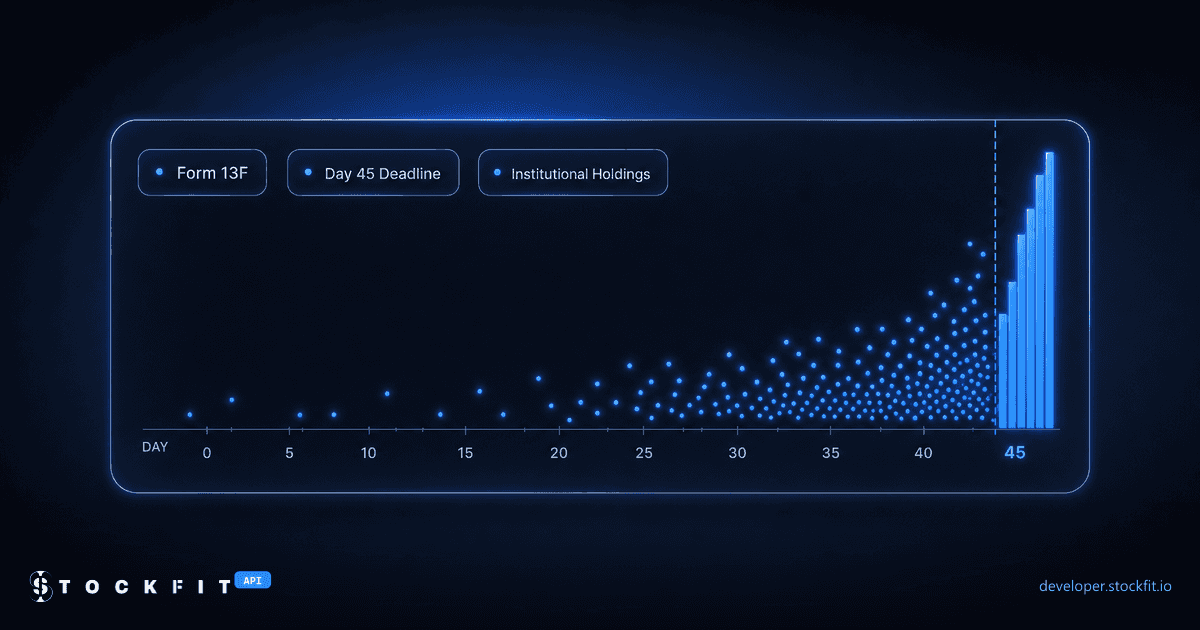
Every "follow the smart money" tool built on Form 13F carries the same asterisk: the position it shows you can be up to 45 days old. We pulled every initial 13F-HR filing StockFit has indexed for the 2025-09-30 quarter, all 8,206 of them, and timestamped each one against its own filing date rather than its quarter-end date. The shape is not subtle. Almost nobody files in the first two weeks. A fifth of the entire quarter files on the exact deadline day.
This is not a complaint about the rule. The 45-day window is nearly 50 years old and exists on purpose. It is a data point every backtest, screener, and "smart money" dashboard built on institutional ownership needs to account for, and one most of them quietly ignore. Below is the actual distribution, a named case study in Berkshire Hathaway, and how to query the data without getting burned by the lag.
What Form 13F-HR discloses, and the 45-day rule
Any institutional investment manager exercising discretion over $100 million or more in qualifying securities must file Form 13F-HR with the SEC, listing every reportable position: issuer, share count, market value, and voting authority. It covers long equity positions only, no short interest and no derivatives beyond a few reportable option types. Well over 8,000 managers file it each quarter, from BlackRock down to single-person family offices that happen to clear the threshold, 8,206 of them for the 2025-09-30 quarter alone.
The filing is due within 45 calendar days after each calendar quarter ends, under Rule 13f-1(a)(1). When day 45 lands on a weekend or a federal holiday, the deadline rolls to the next business day. That sounds like a rounding detail until you see it in the data: it is the reason a huge share of one quarter's filings can land on a day that is not, technically, day 45 at all.
The rule dates to the 1970s, and the 45-day gap was not an oversight. Research on institutional filing behavior (see the front-running and copycat-trading literature summarized in the Wharton Rodney White Center working paper on 13F delay) points to the same incentive our own data shows directly: managers who plan to keep building or unwinding a position have every reason to disclose it as late as the rule allows.
Charting how long managers actually take to file
We used the 2025-09-30 quarter as the primary example: 8,206 initial 13F-HR filings, a clean deadline (Friday, 2025-11-14, no weekend or holiday shift), and no amendments mixed in. Each filing was timestamped by calendar days between its periodEndDate and its actual dateFiled.
By day 17, a little over two weeks in, only 13.3% of the quarter has filed. By day 38, barely five and a half weeks in, the market has just crossed the halfway point at 51.2%. The curve does not really bend upward until the final week, when it jumps from 73.4% (day 44) to 94.1% (day 45) in a single day. Anyone building a "what do institutions own right now" view off 13F data is, for most of the quarter, looking at a small, unrepresentative slice of the eventual dataset. This is exactly what StockFit's own /api/ownership/institutional-holders documents in its own parameter description: pass a stale reportDate deliberately, or the "latest quarter" you get back is the thin, still-filling one.
The deadline is a wall, not a slope
Binning the same quarter into weeks makes the shape obvious: filings build gradually through weeks two through five, more than double in the final week, then 20.7% of the entire quarter, one in five managers, files on the single calendar day the rule allows as a deadline. No other single day comes close.
That is not a one-quarter fluke. We ran the same "share of filings landing in deadline week" calculation (days 44 through 48, wide enough to catch a shifted deadline) across seven consecutive clean quarters.
Between 28.7% and 33.6% of every quarter's filings land in deadline week, every single time, with an average of 31%. The mechanism behind the 45-day rule (give managers room to avoid tipping their hand before they have to) produces the same behavior quarter after quarter, not an artifact of any one filing season.
Berkshire Hathaway files on the deadline, every single quarter
Warren Buffett's reluctance to tip Berkshire Hathaway's hand is well known. Our own filing-date data confirms it precisely: across seven consecutive clean quarters, Berkshire Hathaway Inc (CIK 1067983) filed its Form 13F-HR on the actual legal deadline every single time, not "close to it," the exact day.
| Quarter end | Filed | Lag | Accession number |
|---|---|---|---|
| 2024-06-30 | 2024-08-14 | 45 days | 0000950123-24-008740 |
| 2024-09-30 | 2024-11-14 | 45 days | 0000950123-24-011775 |
| 2024-12-31 | 2025-02-14 | 45 days | 0000950123-25-002701 |
| 2025-03-31 | 2025-05-15 | 45 days | 0000950123-25-005701 |
| 2025-06-30 | 2025-08-14 | 45 days | 0000950123-25-008343 |
| 2025-09-30 | 2025-11-14 | 45 days | 0001193125-25-282901 |
| 2025-12-31 | 2026-02-17 | 48 days (shifted deadline) | 0001193125-26-054580 |
The last row is the most telling. For the 2025-12-31 quarter, the normal 45-day deadline landed on 2026-02-14, a Saturday. Because the following Monday was a federal holiday, the real deadline rolled to 2026-02-17, a Tuesday, exactly the example the SEC's own Form 13F FAQ walks through. Berkshire filed on that exact shifted date, and it was not alone: 1,546 of the 8,863 filings that quarter (more than any other single day) landed on the same shifted deadline. Berkshire is not an outlier here, it is the clearest single illustration of what the whole population does.
How to use 13F data without getting burned by the lag
The practical fix is simple once the shape above is in front of you: never treat "the latest quarter" as complete until its deadline has actually passed. /api/ownership/institutional-holders takes an explicit reportDate for exactly this reason, pin it to the prior quarter end during the 45-day window that follows a new quarter close, rather than trusting whatever "most recent quarter" resolves to by default.
curl 'https://api.stockfit.io/v1/api/ownership/institutional-holders?symbol=AAPL&reportDate=2025-09-30&pageSize=5' \
-H 'Authorization: Bearer $STOCKFIT_API_KEY'{
"page": 1, "pageSize": 5, "totalPages": 1060, "totalResults": 5299,
"data": [
{
"managerName": "VANGUARD GROUP INC", "managerCik": 102909,
"shares": 1256765319, "value": 320010153177, "pctOfShares": 8.6,
"prevShares": 1343278627, "prevPctOfShares": 9.19,
"reportDate": "2025-09-30", "accessionNumber": "0000102909-25-000353"
},
{
"managerName": "BlackRock, Inc.", "managerCik": 2012383,
"shares": 1147921797, "value": 292295327267, "pctOfShares": 7.86,
"prevShares": 1149323171, "prevPctOfShares": 7.87,
"reportDate": "2025-09-30", "accessionNumber": "0002012383-25-002949"
}
// ...
]
}Every row carries the manager's accessionNumber, the exact 13F-HR that position came from, alongside prevShares and prevPctOfShares for change tracking without a second call. For a trend rather than a single quarter, /api/ownership/institutional-holders/history returns the holder count, aggregate shares, and value per quarter going back as far as your plan's history allows, useful for spotting a multi-quarter buildup or exit rather than reacting to one noisy snapshot.
This is the same discipline the point-in-time fundamentals guide covers for financial statements: a fact is not usable until its filing date, not its period date. 13F data just makes the gap between the two unusually large and unusually predictable.
Filing date, not quarter-end date: how StockFit timestamps it
Every institutional holder row carries its source accessionNumber, so any position can be checked against the actual filed document rather than trusted as a normalized number. Given just the accession number, /api/filings/search-by-accession-number resolves the underlying filing directly.
// GET /api/filings/search-by-accession-number?accessionNumber=0001193125-25-282901
{
  "type": "13F-HR",
  "accessionNumber": "0001193125-25-282901",
  "url": "https://www.sec.gov/Archives/edgar/data/1067983/000119312525282901/xslForm13F_X02/primary_doc.xml",
  "dateFiled": "2025-11-14",
  "periodEndDate": "2025-09-30",
  "title": "BERKSHIRE HATHAWAY INC"
}
dateFiled and periodEndDate are both first-class fields, never collapsed into one. That distinction is the entire subject of this post: the second field tells you what quarter a position describes, the first tells you when the market actually learned about it, and every downstream chart, screener, or backtest needs to key off the second one, not the first.
13F is one piece of a wider ownership picture. For concentrated 5% strategic stakes with activist or passive intent attached, see Schedule 13D and 13G beneficial ownership, and for the officer and director trades that move on a two-day clock instead of a 45-day one, our SEC EDGAR alternative data signals roundup covers Form 4 transaction codes alongside seven other filing-derived signals. The full institutional ownership surface, including portfolio-by-manager and quarter-over-quarter activity, is covered on the hedge fund data page, and how to detect accumulation and distribution walks through the position-change mechanics directly. The same lag-versus-freshness question shows up on the fund side too: our ETF holdings cadence investigation measures the gap between a quarterly N-PORT filing and a daily holdings file the same way this post measures the 13F deadline.
Every ownership endpoint used in this post is on the Stock plan ($59/mo, $39/mo billed annually) or Professional ($99/mo, $69/mo billed annually). to try the free-tier endpoints first, no credit card required.
FAQ
Q.Why does 13F institutional holdings data lag up to 45 days?
Q.When do 13F filings actually become public on SEC EDGAR?
Q.What happens when the 13F filing deadline falls on a weekend or holiday?
Q.Why does Berkshire Hathaway always file its 13F at the last possible moment?
Q.Does Form 13F disclose short positions?
Q.How do I get complete 13F coverage for a quarter via API?
reportDate to /api/ownership/institutional-holders pinned to a quarter end whose 45-day window has already closed. Requesting the newest quarter without pinning a date returns whatever has filed so far, which our data shows can be under 15% complete for the first two weeks after quarter end.Q.What is the difference between an initial 13F-HR and an amended 13F-HR/A?
amendment=false in StockFit's filings index). A 13F-HR/A restates some or all of a prior quarter's positions, filed whenever a manager corrects an earlier report. Amendments are excluded from the timing analysis here because they measure a correction, not the original disclosure lag.Q.Which StockFit plan includes institutional ownership data?
Ready to build?
Free API key, no credit card.